Savegen Engineering has established itself as a specialised provider of welding and automation solutions tailored to the evolving needs of industrial manufacturing, construction, energy, and transportation sectors. This essay articulates the company’s core competencies, technical specialisations, service offerings, quality and safety frameworks, and the strategic value it delivers to customers. It further examines the technological foundations of Savegen’s solutions, describes typical project lifecycles, and outlines how the company sustains continuous improvement and adapts to emerging industry trends such as Industry 4.0 and sustainable manufacturing practices.
Savegen Engineering positions itself at the intersection of traditional metalworking craftsmanship and advanced automation technology. The company’s strategic objective is to provide integrated welding and automation solutions that increase productivity, improve product quality, reduce operational risk, and deliver measurable lifecycle cost benefits. Savegen operates across multiple verticals—heavy fabrication, oil and gas, petrochemical and power generation, shipbuilding, rail and automotive sub-supply, and specialized modular construction—where robust, repeatable welding processes and reliable automation are essential.
Specializations
Advanced Welding Processes
Manual and mechanized welding: Savegen specialises in expertise across SMAW (stick), GMAW/MIG, GTAW/TIG, FCAW, submerged arc welding (SAW), and resistance welding, allowing selection of the ideal process for material, joint geometry, and production volume.
Pipe and pressure-vessel welding: Proficiency in ASME Section IX-qualified procedures and welders, with experience in multi-pass techniques, root and cap passes, back-gouging where needed, and post-weld heat treatment (PWHT) coordination for carbon steel, alloy steels, stainless steels and nickel alloys.
High-integrity and critical-application welding: Procedures and personnel qualified for pressure-containing, high-cycle fatigue, and cryogenic applications, accommodating stringent NDT and traceability requirements.
Welding Automation and Robotic Integration
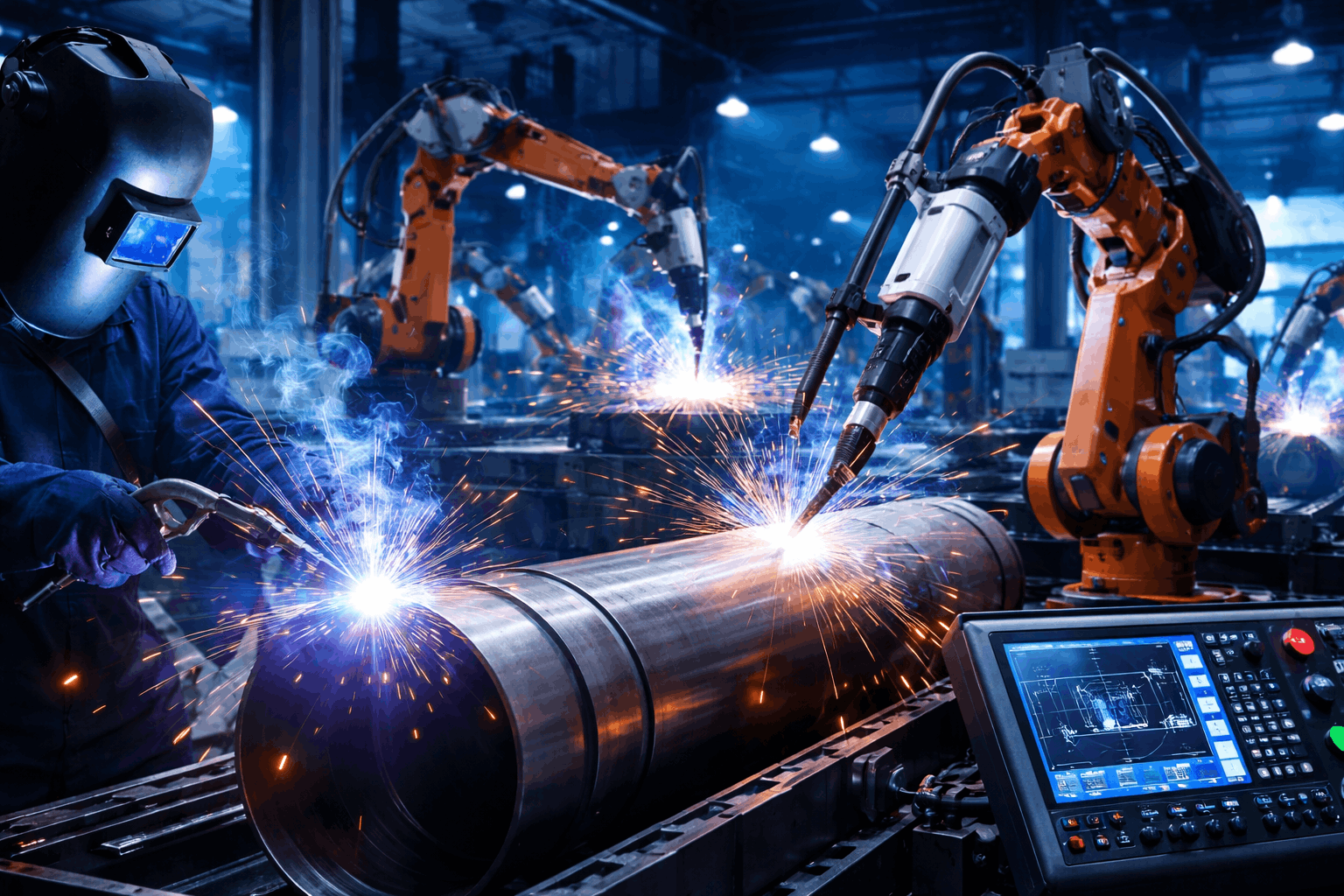
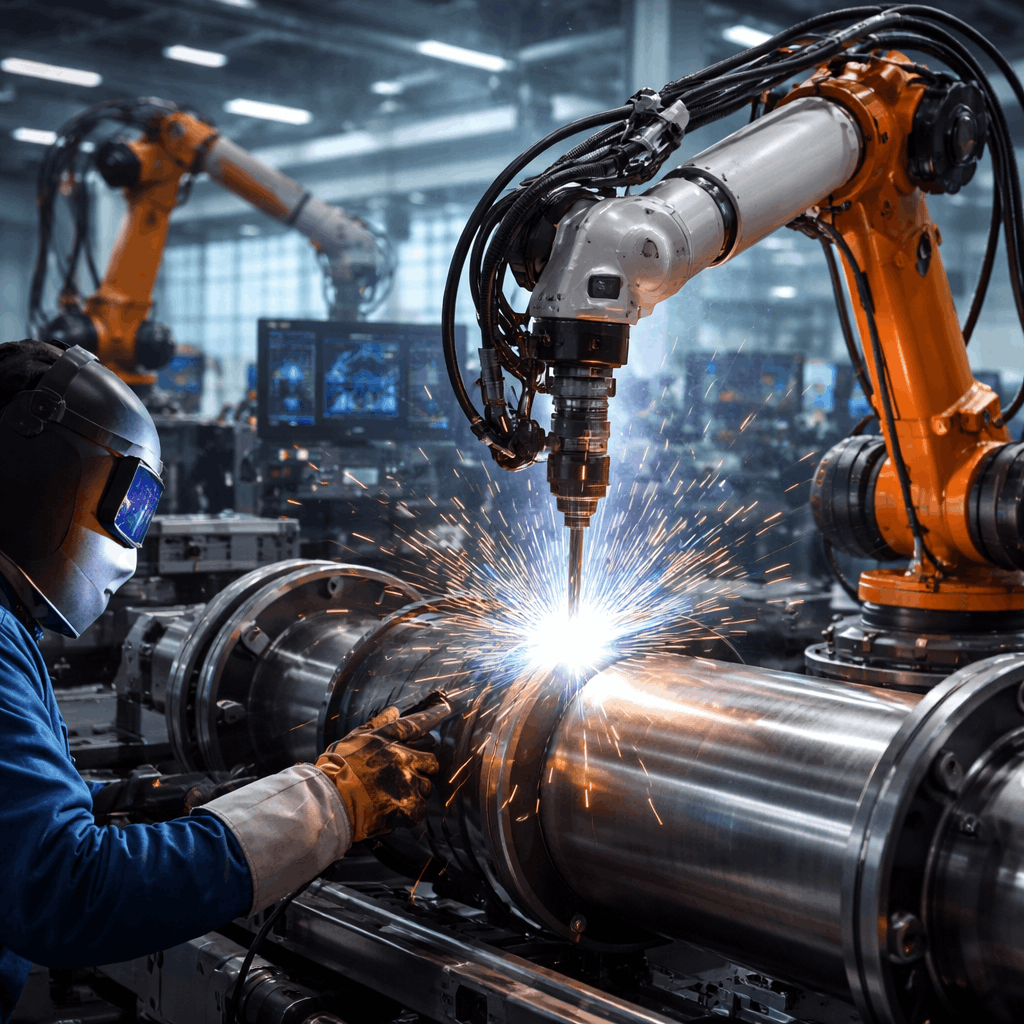
Robotic welding systems: Design, programming, and deployment of industrial robotic cells (arc, MIG/TIG, laser-hybrid welding) including reach and payload matching, end-effector tooling design, positioners, and safety enclosures.
Semi-automated and mechanised solutions: Tractor, column-and-boom, and orbital welding systems for long seams, pipe, and tube welding where full robotics are impractical or unjustified economically.
Adaptive welding controls: Integration of seam-tracking sensors, vision systems, adaptive voltage/current control, and closed-loop feedback to handle part variability and ensure consistent weld quality.
Welding Consumables, Metallurgy, and Procedure Development
Procedure qualification: Development and qualification of WPS/PQR documents in compliance with customer standards and regulatory codes (ASME, AWS, ISO).
Metallurgical consulting: Expertise in filler material selection, preheat and PWHT schedules, and mitigation strategies for hydrogen-induced cracking, solidification cracking, and fatigue-prone designs.
Consumable management: Advising on and supplying electrodes, wires, fluxes and shielding gases optimised for performance and cost.
Fabrication Automation Beyond Welding
Automated material handling: Conveyors, gantries, automated guided vehicles (AGVs), and fixturing to streamline part flow into and out of welding stations, reducing takt time and ergonomic risk.
CNC and combining technologies: Integration of CNC cutting, bending and forming processes with welding cells for fully automated fabrication lines.
Quality inspection automation: Inline NDT technologies (ultrasonic phased array, eddy current, radiography automation, laser profilometry) and machine vision systems for realtime defect detection and process feedback.
Maintenance, Support and Lifecycle Services
Preventive and predictive maintenance: Scheduled inspections, calibration and component replacement programs, together with condition-based monitoring to reduce downtime.
Spare parts and consumable supply: Managed spares programs and replenishment services to keep lines running.
Remote diagnostics and support: Secure remote connectivity for troubleshooting, software updates, and performance analytics to minimize mean time to repair.
Quality, Safety and Compliance
Quality assurance and safety underpin Savegen’s technical credibility. The company maintains rigorous processes:
Certification and standards: Compliance with ISO 9001 quality management systems and alignment with ISO 3834 for welding quality where applicable. Procedures structured to meet ASME, AWS, EN and customer-specific standards.
NDT and inspection: In-house and partner capabilities for MT, PT, UT (including phased array), RT, and dimensional inspection. NDT procedures integrated into process flows with traceable records.
Traceability and documentation: Full material and process traceability—material certificates, WPS/PQR, welder qualifications, NDT reports and nonconformance logs—delivered via electronic documentation systems when required.
Health, Safety and Environment: HSE programs that enforce safe robotic cell layouts, lockout/tagout practices, ventilation and fume extraction for welding operations, and compliance with local regulatory requirements.
Cybersecurity for automated systems: Measures to protect PLCs, HMIs and MES links from unauthorized access and to ensure safe operation of automated assets.
Technology and Innovation
Savegen continuously invests in technologies that elevate process reliability and productivity:
Industry 4.0 integration: Collection of process and equipment data for analytics, KPI dashboards, and predictive maintenance. Use of digital twins for cell-side simulation and optimization prior to physical deployment.
Advanced sensors and AI: Adoption of advanced seam-tracking, arc sensing and machine-vision algorithms; exploration of AI for weld defect recognition and for adaptive parameter tuning.
Hybrid welding technologies: Implementation of laser-hybrid and plasma-hybrid processes where appropriate, delivering deep penetration, lower heat input, and increased welding speed.
Energy efficiency and sustainability: Initiatives to reduce power consumption per unit produced through optimized weld schedules, efficient inverter power sources, and automated processes that reduce rework and scrap.
Typical Project Lifecycle
Savegen approaches projects through a structured lifecycle ensuring technical rigor and stakeholder alignment:
Discovery and Concept: Requirements gathering, site surveys and conceptual designs combined with ROI modelling.
Detailed Engineering: Selection of equipment, development of WPS, robotic programs, tooling design and safety plans.
Fabrication and Assembly: Manufacturing and assembly of fixtures, enclosures, and mechanical components in Savegen workshops or partner facilities.
Factory Acceptance Testing (FAT): Pre-delivery validation of equipment performance, programming and safety interlocks.
Site Installation and SAT: On-site assembly, commissioning, programming adjustments and performance testing under production conditions.
Handover and Training: Delivery of documentation, training sessions and knowledge transfer to client personnel.
Operation and Continuous Improvement: Monitoring performance, maintenance support and iterative optimization.
Case Examples (Representative Scenarios)
High-throughput structural fabrication: Deployment of multi-robot cells with synchronized positioners and automated feeding systems enabling precise, repeatable welds on large structural assemblies, improving throughput and cutting rework.
Critical piping systems: Qualification and delivery of mechanised orbital welding systems and experienced welding crews for high-purity or high-pressure piping, with full material traceability and NDT reporting to regulatory standards.
Retrofit automation: Upgrading legacy fabrication lines with robotic weld cells and automated handling to reduce cycle time and improve safety while preserving existing fixtures and floor layout.
Economic and Operational Benefits
Savegen’s integrated approach yields quantifiable benefits:
Productivity increase: Faster cycle times, reduced setup and changeover, and 24/7 repeatable operation where applicable.
Quality improvement: Reduced weld defects, consistent weld profiles, and higher first-pass yield with attendant reductions in rework and scrap.
Cost predictability: Lower labor intensity for repetitive tasks, reduced variability and more predictable throughput enabling tighter production planning.
Safety and ergonomics: Removal of operators from hazardous zones, reduced exposure to fumes and repetitive strain, and automated handling of heavy components.
Scalability: Solutions that can be expanded or reconfigured as volumes and part families evolve.
Challenges and Mitigation Strategies
Successful welding automation requires managing several challenges:
Part variability and fixturing complexity: Addressed through robust fixture design, adaptive sensing and tolerances in product design.
Upfront capital investment: Mitigated using phased implementation, leasing, or shared-capex models and clear ROI analyses.
Skilled workforce availability: Managed via training programs, apprenticeship models, and partnering to upskill internal teams.
Integration complexity: Overcome by rigorous systems engineering, simulation, and staged commissioning with supplier coordination.
Savegen Engineering’s specialisation in welding and automation combines deep metallurgical and welding-process knowledge with modern automation, controls and systems-integration capabilities. By providing end-to-end services—from consulting and procedure development to robotic cell delivery, commissioning, training and lifecycle support—Savegen helps industrial organisations achieve higher throughput, improved weld quality, enhanced safety and lower total cost of ownership. Looking forward, the company’s continued investment in Industry 4.0 enablers, advanced sensing and adaptive control will further increase the value delivered to clients, while also supporting sustainability and resiliency in industrial manufacturing.
SERVICE DETAILS
Process audits: Evaluations of existing welding and fabrication operations to identify bottlenecks, quality shortfalls, safety exposures and automation candidates.
ROI and feasibility studies: Technical and commercial assessments to prioritize investments in automation or process upgrades and to estimate payback, throughput gains and total cost of ownership.
System engineering: Concept-to-detail engineering of robotic welding cells, material handling systems, and integration with plant controls, including electrical schematics, PLC programming and HMI design.
Fixture and tooling design: Custom jigs and positioners to ensure repeatable workpiece orientation and fixturing across automated and manual operations.
On-site deployment: Project management and field teams to install equipment, perform utility tie-ins, establish safety systems and complete mechanical and electrical commissioning.
Controls integration: PLC/SCADA integration with enterprise systems such as MES and ERP, enabling production scheduling, traceability and performance monitoring.
Operator and maintenance training: Hands-on programs for welders, robotic programmers, and maintenance technicians to build internal competency and ensure safe, effective operation.
Procedure and welder qualification: Managing qualification testing and documentation to meet relevant codes and customer specifications.
Have you any question or querry
GET FREE
CONSULTATION
WITH OUR AGENT