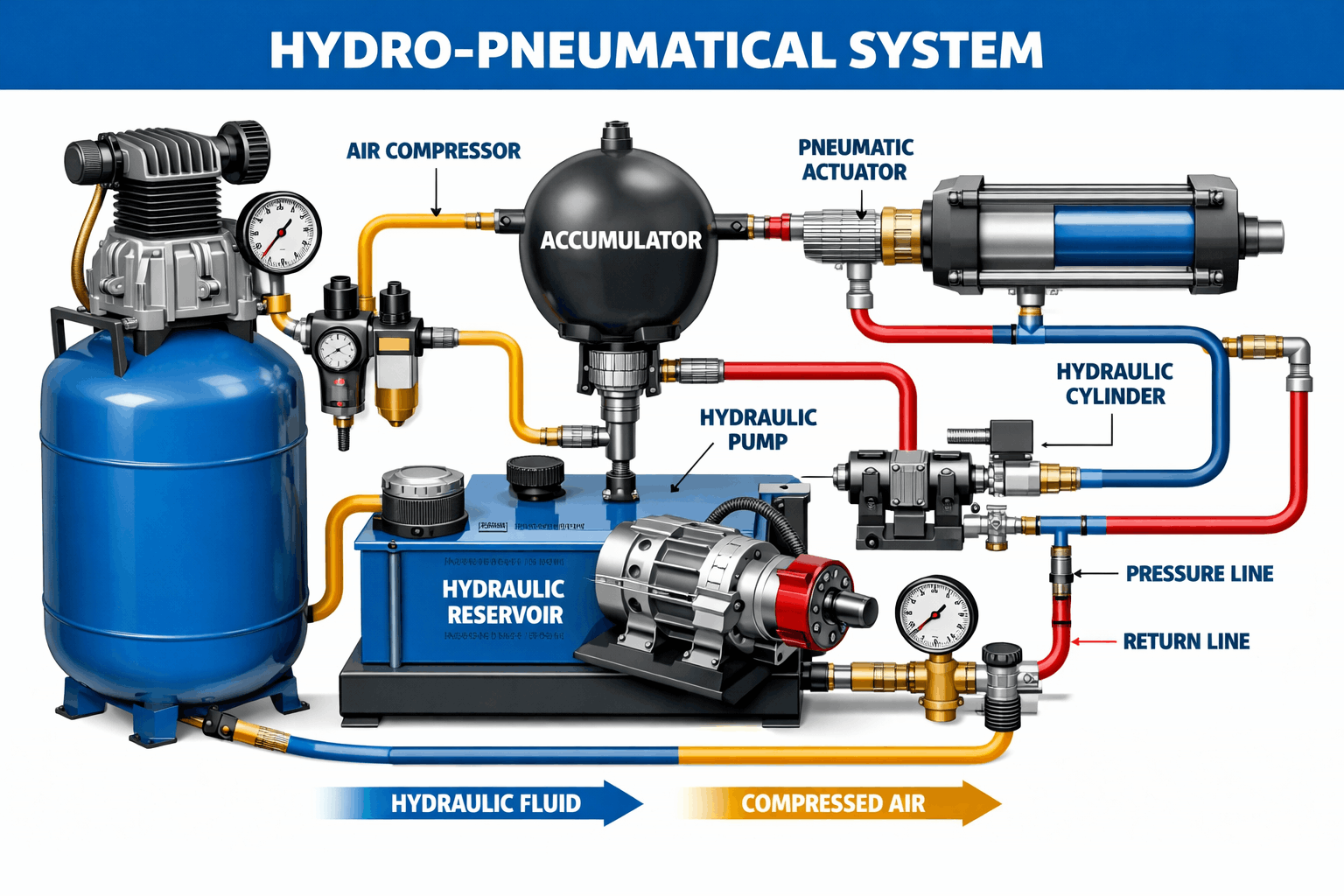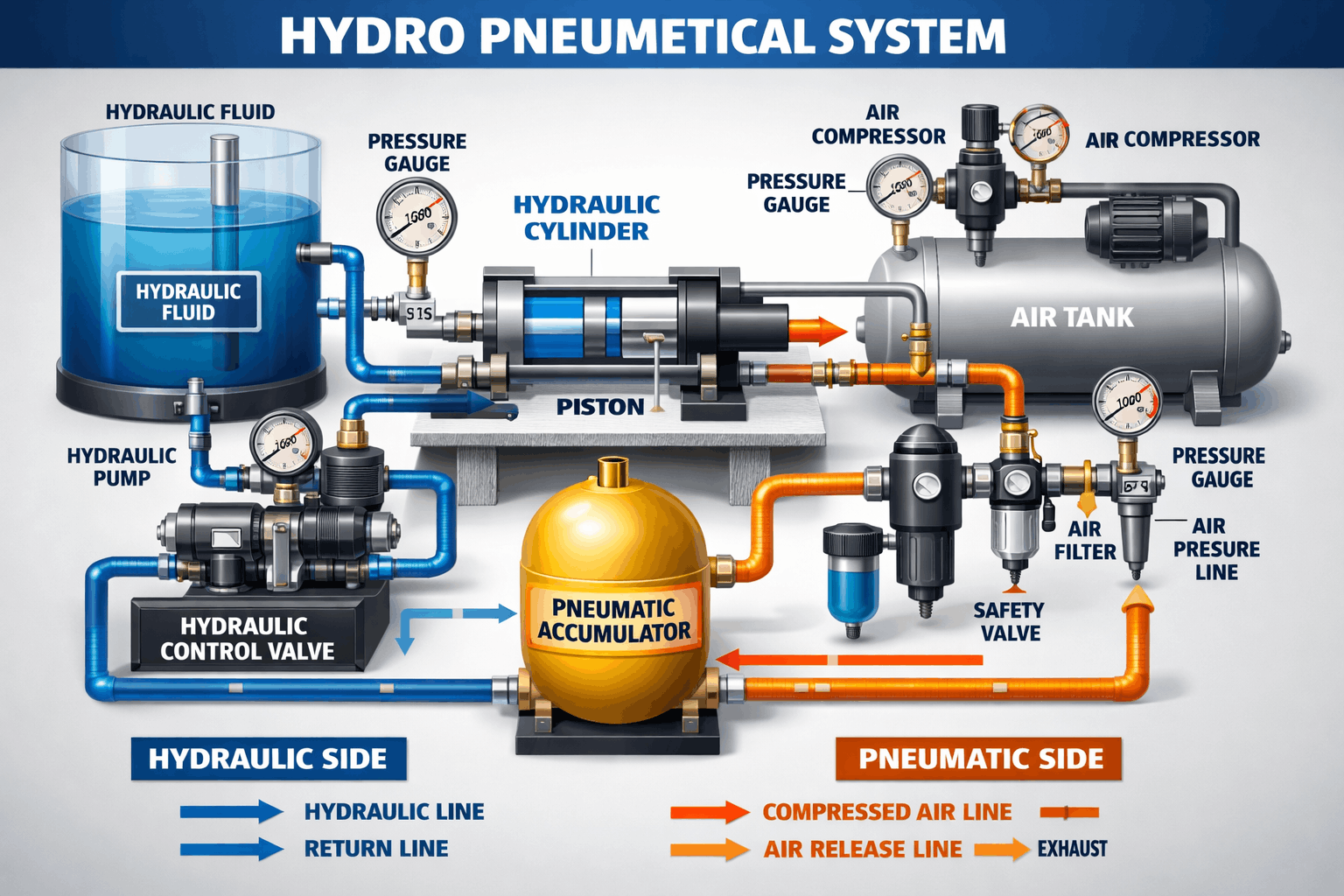
Savegen Engineering is a specialist engineering firm focused on the design, manufacture, integration, and life-cycle support of hydro-pneumatical systems. These hybrid systems—combining hydraulic and pneumatic technologies—are deployed across diverse industrial applications where the complementary strengths of incompressible-fluid power (hydraulics) and compressible-gas power (pneumatics) yield performance, safety, and efficiency advantages. This essay outlines Savegen Engineering’s core specialisations, technical competencies, typical system architectures, engineering and service processes, quality and safety practices, and value propositions to customers.
Hydraulic systems deliver high force and precise position/control characteristics through incompressible liquids, making them ideal for heavy-load actuation and energy-dense power transfer. Pneumatic systems, by contrast, offer rapid response, inherent compliance, cleaner operation in some contexts, and economical actuation for lower-force tasks. Hybrid hydro pneumatical systems exploit both domains: pneumatic accumulators or cushions introduce compliant energy storage and shock absorption; hydraulics provide accurate, high-force actuation; and controlled pneumatic elements can assist or modulate hydraulic behavior to reduce peak loads, limit shock, and improve energy efficiency.
Industries that commonly benefit from hydro pneumatical solutions include: oil & gas (wellhead control, blowout preventer actuation), maritime and offshore (deck machinery, launch-and-recovery systems), mining and heavy equipment (boom and shear control), renewable energy (pitch and yaw controls), industrial automation (hybrid presses, stamping), and defense/aerospace (landing gear and weapon-ejection mechanisms). Savegen actively targets these sectors with tailored systems and integrated services.
Specializations
Control Systems and Electronics
Motion control algorithms: adaptive feedforward, model predictive, and PID-based schemes that account for compliance and nonlinearity introduced by pneumatic elements.
Sensor fusion: integrating pressure transducers, position encoders, flow meters, temperature sensors, and accelerometers to support closed-loop control and predictive maintenance.
Safety instrumented systems (SIS): fail-safe logic, redundancy strategies, emergency shutdown sequences, and functional safety compliance (e.g., IEC 61508, ISO 13849 where applicable).
Testing, Validation, and Certification
Factory acceptance testing (FAT) and site acceptance testing (SAT): comprehensive hydrostatic, pneumatic leak, endurance, and functional testing under simulated loads and environmental conditions.
Dynamic testing: fatigue testing, transient response characterization, and shock/impact validation with high-speed data acquisition.
Regulatory and classification compliance: ensuring systems meet industry regulations (e.g., API for oil & gas, DNV for marine/offshore) and achieving certifications required by clients and authorities.
Lifecycle Services and Support
Commissioning and start-up: on-site assembly, system tuning, performance validation, and operator training.
Predictive and preventive maintenance: condition monitoring, remote diagnostics, vibration and pressure trend analysis, and parts provisioning to minimize downtime.
Refurbishment and upgrades: retrofitting legacy systems with modern control and sensor packages, or converting purely hydraulic or pneumatic systems to hybrid designs to enhance performance.
Spare parts and logistics: managed inventory, rapid-response kits, and global support networks to maintain uptime in critical installations.
Typical Hydro Pneumatical System Architectures
Savegen’s design practice yields several archetypal architectures tailored to application needs:
Pneumatic-Buffered Hydraulic Actuation: A hydraulic cylinder provides primary force and position control. A pneumatic accumulator or cushion located at the end-of-stroke absorbs impact energy, reduces peak hydraulic pressures, and extends component life. Valving and damping are arranged to control fill/drain rates during motion transitions.
Pneumatically Assisted Hydraulic Drive: Pneumatic preloading applied to a hydraulic cylinder reduces required hydraulic force and pump sizing. This architecture improves energy efficiency for cyclic loads by sharing energy between gas compression and hydraulic fluid.
Hydraulic Primary with Pneumatic Emergency Backup: Critical systems require graceful degradation. Pneumatic accumulators or compressed-gas actuators provide fail-safe actuation for emergency shutdowns when hydraulic power is unavailable, with careful attention to sealing and gas retention.
Integrated Skid Systems: Compact, packaged skids combine pumps, compressors, accumulators, tanks, filtration, cooling, manifolds, safety devices, and control electronics for plug-and-play integration in plant, vessel, or vehicle platforms.
Engineering Process and Project Delivery
Requirements Capture and Feasibility Savegen begins with structured requirement elicitation—operational profiles, environmental constraints, reliability targets, maintainability, interfaces, and safety requirements. Feasibility studies include trade-off analyses for energy consumption, lifecycle cost, weight/space constraints, and maintainability.
Conceptual and Detailed Design Concepts are translated into system diagrams, P&IDs, 3D CAD models, and engineering calculations for sizing. Dynamic simulation—covering pneumatics (compressible flow) and hydraulics (incompressible flow)—validates transient responses and energy flows. Materials, tolerances, and manufacturing methods are specified.
Prototyping and Iterative Verification Prototypes and test rigs are fabricated to validate behavior under representative loads. Instrumentation captures pressure, displacement, flow, and acceleration data. Results inform iterative design changes to valves, accumulator sizing, and control firmware.
Manufacturing and Assembly Components are produced in-house or by vetted suppliers with quality control procedures. Skid assembly emphasizes modularity, accessibility for maintenance, and clear labeling. Integrated electrical cabinets and control layers are installed following EMC and ingress-protection standards.
Commissioning and Handover On-site commissioning verifies system integration, control tuning, and operator procedures. Formal documentation—operation manuals, maintenance schedules, calibration certificates, and as-built drawings—is provided. Training sessions ensure operator competence and safety awareness.
After-Sales Support Support agreements include scheduled maintenance visits, remote monitoring and troubleshooting, spare-parts supply, and performance audits. Savegen offers condition-based maintenance programs leveraging sensor data to predict component wear and avoid unplanned outages.
Quality, Safety, and Risk Management
Standards and Procedures: Savegen adheres to international quality frameworks (e.g., ISO 9001) and industry-specific standards, including those governing pressure equipment, welding, electrical systems, and safety-instrumented systems.
Hazard Analysis: HAZOP and FMEA analyses are applied to identify failure modes associated with combined fluid domains (e.g., inadvertent gas migration into hydraulic circuits, accumulator rupture, seal failure), with mitigation strategies such as redundant sensors, pressure relief pathways, and interlocks.
Material Certification and Traceability: Material traceability and non-destructive testing (NDT) practices ensure integrity of pressure-bearing components. Accumulators and high-pressure vessels undergo rigorous inspection and certification.
Environmental and Operational Safety: Designs minimize leakage, venting, and contamination. For subsea or offshore applications, attention to spill prevention and environmental containment is paramount.
Technical Challenges and Savegen’s Mitigation Strategies
Compressibility Interaction: Combining compressible and incompressible media can create complex transients. Savegen mitigates this via high-fidelity simulation, conservative accumulator sizing, staged valving, and active control strategies.
Sealing and Gas Migration: Preventing gas ingress into hydraulic fluid is essential. Solutions include positive isolation, robust sealing technologies, venting strategies, and routine gas-content monitoring of hydraulic fluids.
Thermal Management: Gas compression and hydraulic power losses generate heat. Savegen designs appropriate heat exchangers, thermal buffers, and control logic to maintain optimal fluid temperatures.
Maintenance Complexity: Hybrid systems can increase service complexity. Savegen emphasizes modular design, clear diagnostics, training, and spares planning to keep maintenance straightforward and rapid.
Value Proposition to Customers
Performance Optimization: By blending hydraulic force density with pneumatic compliance and energy storage, Savegen’s systems improve cycle times, reduce peak power demands, and extend component life.
Reduced Total Cost of Ownership: Energy-efficient designs, predictive maintenance, and system modularity lower operational costs and reduce downtime.
Tailored Solutions and Rapid Deployment: Savegen offers both custom designs for unique challenges and standardized skid packages for faster integration, allowing customers to match investment to need.
Safety and Reliability: Rigorous engineering, testing, and adherence to standards reduce operational risk and ensure robust performance in harsh conditions.
Lifecycle Support: End-to-end services—from design through refurbishment—ensure systems remain fit for purpose throughout their operational life.
Case Illustrations (Representative Examples)
Offshore BOP Actuation Enhancement: Replacing a legacy hydraulic-only actuation system for blowout preventers with a hydro-pneumatical hybrid yielded reduced pump sizing by leveraging pneumatic preloading, improved shock absorption during rapid closing events, and enhanced fail-safe actuation capability via stored gas.
Hybrid Deck-Crane Energy Recovery: A marine deck crane retrofitted with a pneumatic accumulator system captured lowering energy and re-used it to assist subsequent lifts, reducing fuel consumption and hydraulic pump duty cycles.
Industrial Press with Pneumatic Cushioning: A high-precision stamping press integrated pneumatic cushions to absorb end-of-stroke impacts, reducing stamping defects and extending die life while maintaining hydraulic position accuracy.
Savegen Engineering’s domain expertise in hydro-pneumatical systems positions the firm to deliver advanced, application-specific solutions that leverage the complementary strengths of hydraulics and pneumatics. Their multidisciplinary competencies—spanning system design, controls, custom fabrication, testing, certification, and lifecycle support—address the technical challenges of integrating compressible and incompressible fluid domains while delivering measurable benefits in performance, safety, and operating cost. For industries requiring high-force precision coupled with compliance, energy efficiency, and robust safety, Savegen’s hybrid approach provides a compelling engineering pathway from concept through decades of reliable service.
SERVICE DETAILS
Hybrid design: conceptualizing and detailing combined hydraulic pneumatic circuits, specifying where pneumatic compliance or hydraulic precision is advantageous.
Multi-domain modelling: using bond-graph, fluid-network, and dynamic simulation tools to capture coupled compressible/incompressible fluid dynamics, thermal effects, and transient phenomena (water hammer, gas spring response).
Selecting pumps, compressors, valves, accumulators, reservoirs, actuators, filters, heat exchangers, and sensors that match duty cycles, power requirements, environmental constraints, and maintainability targets.
Controls integration: designing electro-hydraulic and electro-pneumatic control strategies, choosing proportional and servo valves, and integrating PLC/embedded controllers and HMI for deterministic control, feedback, and diagnostics.
Accumulators and pneumatic energy-storage devices: custom bladder, piston, or diaphragm accumulators optimized for specific pressure ranges, volume, and lifecycle requirements.
Hybrid actuators: designing cylinders and rotary actuators with integrated pneumatic cushioning, position sensing, and redundant sealing for harsh environments.
Compact, serviceable manifolds combining hydraulic and pneumatic valving, filtration, and safety interlocks built for modular deployment.
Corrosion resistant materials and surface treatments: specialist metallurgy and coatings for subsea, offshore, and chemically aggressive conditions.
Have you any question or querry
GET FREE
CONSULTATION
WITH OUR AGENT