Savegen Engineering is a specialist provider in the field of sheet metal fabrication, with a particular focus on precision bending services. Sheet metal bending is a core capability in many industries—automotive, aerospace, telecommunications, consumer electronics, construction, and industrial equipment—because it transforms flat metal stock into three-dimensional components that meet functional, structural, and aesthetic requirements. This essay details Savegen Engineering’s specialization in sheet metal bending, examining technical capabilities, process control, equipment and tooling, material expertise, design-for-manufacture considerations, quality assurance, ancillary services, and typical applications. It concludes with reflections on how Savegen positions itself to meet modern manufacturing challenges such as customization, short lead times, and sustainability.
Precision forming of a wide range of materials: carbon steels, stainless steels, aluminum alloys, and specialty metals. Each material requires different bend allowances, springback compensation, and tooling choices.
Capability across thickness ranges: thin-gauge sheet used in electronics enclosures up to heavy-gauge plate components for structural and industrial applications. This breadth permits Savegen to serve multiple market segments.
Specializations
Complex bend geometries: multi-bend parts, tight-radius bends, offset and hem features, partial bends (bends that do not fully penetrate), and features that integrate bending with other operations (notches, louvers, and tabs).
Repeatability and tolerances: maintaining tight dimensional tolerances (often within ±0.1–0.5 mm depending on geometry and material) through CNC control and automated measurement feedback.
Material Expertise and Process Control
Bending sheet metal is governed by material mechanical properties—yield strength, tensile strength, elongation, and anisotropy—along with thickness, grain direction, and surface treatment. Savegen’s engineers apply material science knowledge to predict and control forming outcomes:
Springback Compensation: Springback, the elastic recovery after forming, varies by material and requires angle over-bend or die compensation. Savegen employs empirical data, finite element analysis (FEA) when necessary, and historical process capability to program precise compensation for each material and geometry.
Bend Allowance and K-Factor Selection: Correctly calculating bend allowance and using appropriate K-factors ensures final part dimensions meet design intent. Savegen adapts these calculations for different materials, thicknesses, and bend radii.
Grain Direction and Anisotropy Considerations: For some materials, bending across or along the grain affects crack propensity and final geometry. Savegen advises on blank orientation to minimize risks and improve part performance.
Surface Finish and Handling: For visible components or plated parts, surface protection, low-contact fixturing, and appropriate lubrication strategies prevent scratches and marring during bending. Handling procedures and packaging are established to preserve finish integrity to delivery.
Design for Manufacture (DFM) and Engineering Support
A key differentiator for specialized sheet metal bending providers is the ability to guide customers in designing parts that are efficient to produce, maintain required performance, and are cost-effective. Savegen offers engineering collaboration and DFM advice covering:
Bend Sequence Optimization: Determining the order of bends to avoid collision, ensure accessibility, and minimize springback accumulation. Proper sequencing can reduce tooling changes and secondary operations.
Minimal Tool Changes and Standardization: Recommending design modifications to use standard dies or to combine features so that parts can be formed with fewer tool setups, lowering per-piece cost for medium- and high-volume runs.
Corner and Tab Design: Guidelines on bend radii, reliefs, hem types, and tab geometry to prevent cracking while satisfying strength and assembly requirements.
Material Selection: Recommending materials that balance weight, corrosion resistance, strength, and cost while ensuring good formability.
Prototyping and Iterative Development: Rapid prototype runs to validate designs, test fit-up, and refine tolerances before committing to production tooling investments.
Quality Assurance and Inspection
Consistency and traceability are critical in precision bending. Savegen employs structured QA processes:
In-process Monitoring: Use of angle sensors, displacement sensors, and iterative test bends to validate bend angles and dimensions during set-up. Automated or manual measurement checks at specified intervals maintain process control.
Metrology and Inspection: Coordinate measuring machines (CMM), optical comparators, laser scanners, and contact gauges are used to verify critical dimensions, hole locations, and form accuracy. For high-volume runs, statistical process control (SPC) tracks key metrics and signals drift before out-of-tolerance parts are produced.
Documentation and Traceability: Material certifications, process parameters, tooling identification, and inspection records are maintained to support audits, warranty claims, and regulated industry requirements (e.g., aerospace or medical where applicable).
Continual Improvement: Root-cause analysis, corrective action tracking, and tooling lifecycle management ensure ongoing improvements in yield and reductions in scrap.
Ancillary Services and Value-Added Capabilities
To offer a full-service solution, Savegen integrates bending with adjacent fabrication capabilities:
Cutting and Blank Preparation: Laser cutting, plasma cutting, or turret punching for blanks with tight tolerances and consistent hole placement.
Secondary Forming and Joining: Welding (MIG, TIG, resistance), riveting, clinching, and fastening to assemble bent components into subassemblies.
Surface Finishing: Powder coating, painting, electroplating, anodizing (for aluminum), passivation (for stainless steel), and other corrosion-protection processes provided or coordinated to deliver finished parts.
Kitting and Assembly: Subassembly, part kitting, and packaging tailored to customer supply-chain needs. Just-in-time (JIT) and Kanban delivery models may be supported.
Prototyping and Low-Volume Production: Rapid prototype and bridge production services to support design verification and initial market entry without full-scale tooling investments.
Typical Applications and Market Segments
Savegen’s sheet metal bending specialization supports a wide array of industries:
Telecommunications and Data Centers: Racks, server chassis, cable trays, and mounting hardware with precise hole patterns and airflow features.
Industrial Equipment and Enclosures: Control cabinets, housings, panels, and protective covers requiring robustness and environmental sealing.
Consumer Electronics: Precision enclosures and frames where cosmetic finish and tight tolerances are essential.
Automotive and Transportation: Brackets, reinforcements, and mounting structures that demand repeatable forming and material strength.
Architectural and Construction: Facade panels, metal assemblies, and support brackets with large-format bending needs.
Medical and Aerospace (where applicable): Components requiring traceability, tight tolerances, and compliance with strict material and process standards.
Operational Excellence: Lead Times, Flexibility, and Cost Management
In contemporary manufacturing environments, customers require shorter lead times, higher part-mix flexibility, and cost-effective production. Savegen addresses these needs through:
Flexible Manufacturing Systems: Quick-change tooling, adaptive robotics, and modular workcells that reduce changeover times and support small-batch runs economically.
Inventory and Supply Management: Sourcing strategies for raw materials and consumables to mitigate lead-time variability and maintain competitive pricing.
Process Automation Where Appropriate: Automated loading/unloading, part orientation, and measurement to accelerate throughput and reduce human error while preserving quality.
Cost Modeling and Production Planning: Transparent quotation processes that account for tooling amortization, labor, machine hours, and finishing, enabling customers to make informed trade-offs between unit cost and batch size.
Sustainability and Responsible Manufacturing
Sustainability considerations are increasingly important in metal fabrication. Savegen can implement measures to reduce environmental impact:
Material Utilization and Nesting: Efficient nesting for cut blanks reduces scrap and lowers raw material consumption.
Recycling and Scrap Management: Segregation and recycling of metal offcuts and responsibly disposing of chemical wastes from finishing processes.
Energy Efficiency: Selection of energy-efficient electric press brakes and optimized production scheduling to reduce peak energy consumption.
Lifecycle Thinking: Advising customers on material choices and finishes that improve product longevity and recyclability.
Risk Management and Compliance
For specialized bending work, risk factors include tooling failure, material variability, and process drift. Savegen manages these through:
Preventive Maintenance: Scheduled maintenance for press brakes, back-gauge systems, and hydraulic/electric drives to prevent downtime and maintain accuracy.
Supplier Qualification: Vetting material suppliers for certificate of compliance and consistent lot-to-lot properties.
Health and Safety: Compliance with local occupational safety standards for press operation, guarding, and manual handling, as well as training programs for operators.
Regulatory Compliance: Meeting industry-specific requirements (ROHS, REACH, or sectoral standards) and providing necessary documentation.
Case Examples (Illustrative)
High-mix Electronics Enclosures: A customer producing a range of server enclosures required low-volume, precision bends with various hole patterns. Savegen implemented CNC press brakes with quick-change tooling and multi-axis back gauges, enabling rapid changeover and consistent quality across SKUs.
Heavy-gauge Structural Brackets: For industrial machinery, Savegen provided bending services on thick carbon steel plate using high-tonnage hydraulic brakes and custom dies, with pre- and post-heat treatment coordination to ensure mechanical performance.
Cosmetic Aluminum Panels: A consumer appliance maker demanded scratch-free surfaces and consistent bend radii. Savegen adopted protective fixturing, controlled lubrication, and final cosmetic inspection to meet aesthetic standards while maintaining dimensional accuracy.
Savegen Engineering’s specialization in sheet metal bending is a synthesis of technical knowledge, process control, appropriate capital equipment, and customer-oriented services. By mastering material behavior, investing in CNC forming equipment and advanced tooling, and offering engineering collaboration for DFM, Savegen achieves high precision, repeatability, and cost-effective production across diverse market segments. Complementary capabilities—cutting, joining, finishing, inspection, and assembly—allow Savegen to deliver turnkey solutions. Ongoing focus areas such as automation, sustainability, and supply-chain resilience position Savegen to meet the evolving demands of modern manufacturing and to support customers from prototype through full-scale production.
SERVICE DETAILS
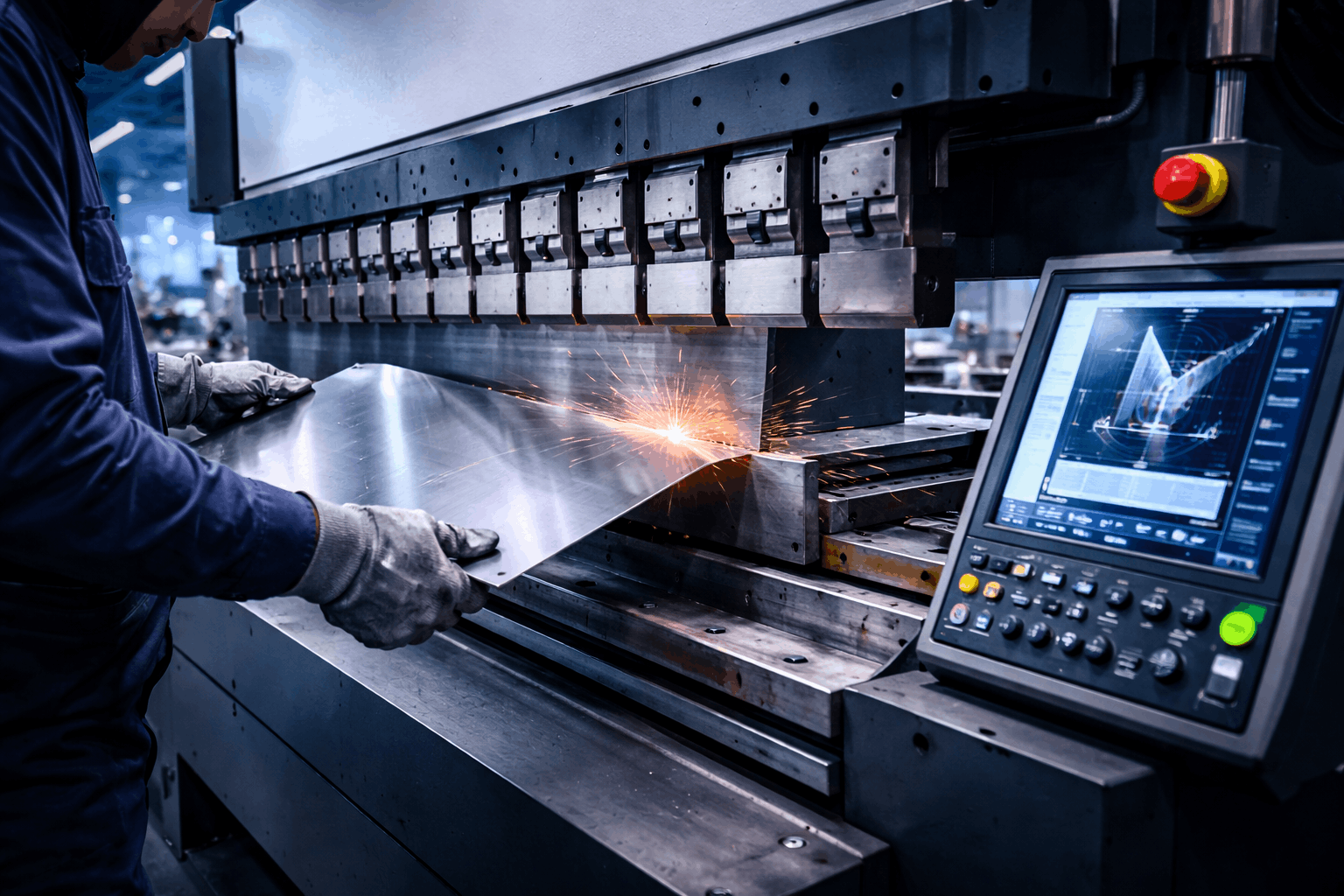
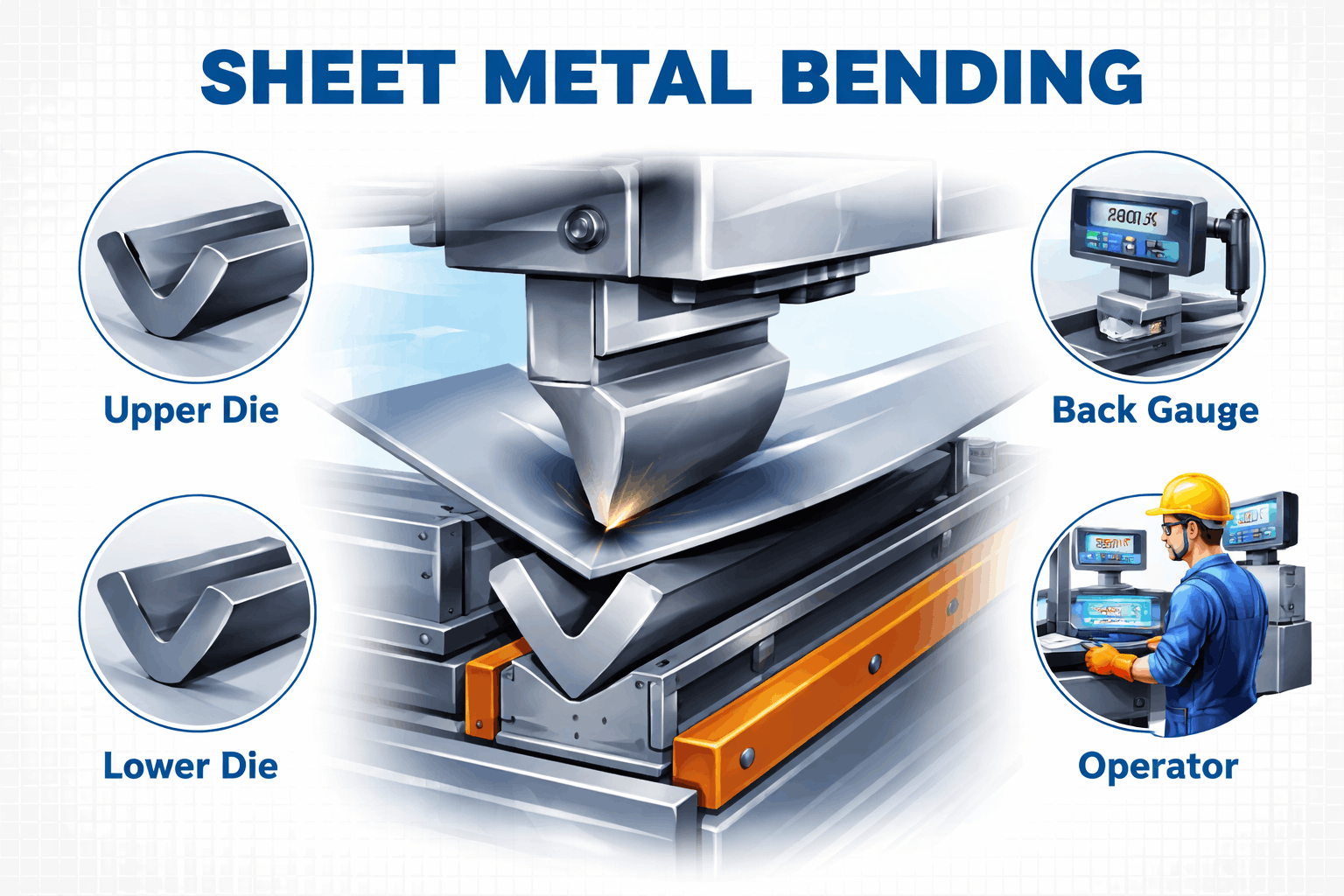
Modern hydraulic and electric press brakes with CNC-controlled ram and back-gauge systems allow programmed bending sequences, precise angle control, and repeatable positioning. Electric press brakes provide higher energy efficiency and faster cycle times for many applications, while hydraulic machines handle higher tonnages for thicker materials.
For complex parts and high-mix production, multi-axis back gauges (including lateral movement, rotation, and adjustable stops) and robotic part handling permit automated, consecutive bending operations with minimal human interaction. Robotic bending cells expand throughput and reduce handling-induced variation.
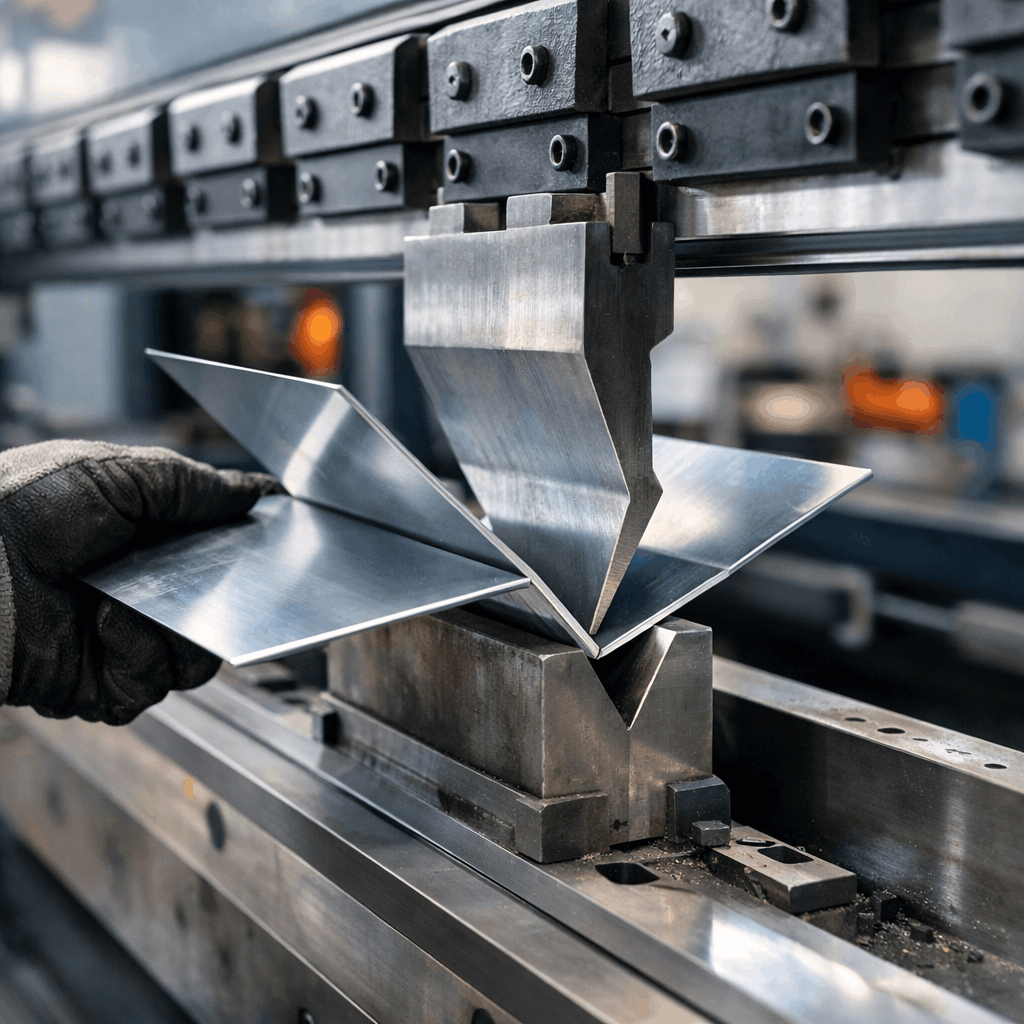
V-dies of varying widths, hemming, coined, and special-form dies, as well as custom tooling for unique geometries, permit Savegen to tailor forming conditions to each part. Hardened tool steels and quick-change systems reduce set-up times and preserve die life.
Integration with laser cutting or turret punching for blanking and preliminary feature formation streamlines workflow; parts arrive at bending as near-net-shape blanks, minimizing secondary operations.
Have you any question or querry
GET FREE
CONSULTATION
WITH OUR AGENT