Savegen Engineering has established itself as a reputable provider of industrial services, with blasting among its core specialisations. Blasting operations form a critical component of surface preparation, asset refurbishment, maintenance, and protection strategies across many industries including construction, petrochemical, marine, power generation, rail, and heavy manufacturing. This essay provides an in-depth examination of Savegen Engineering’s blasting specialisation: the technical scope, methodologies, health and safety practices, quality assurance, environmental considerations, project management approach, and value proposition. The objective is to present a comprehensive, professional assessment of how Savegen delivers blasting services that meet stringent regulatory, technical, and customer-driven requirements.
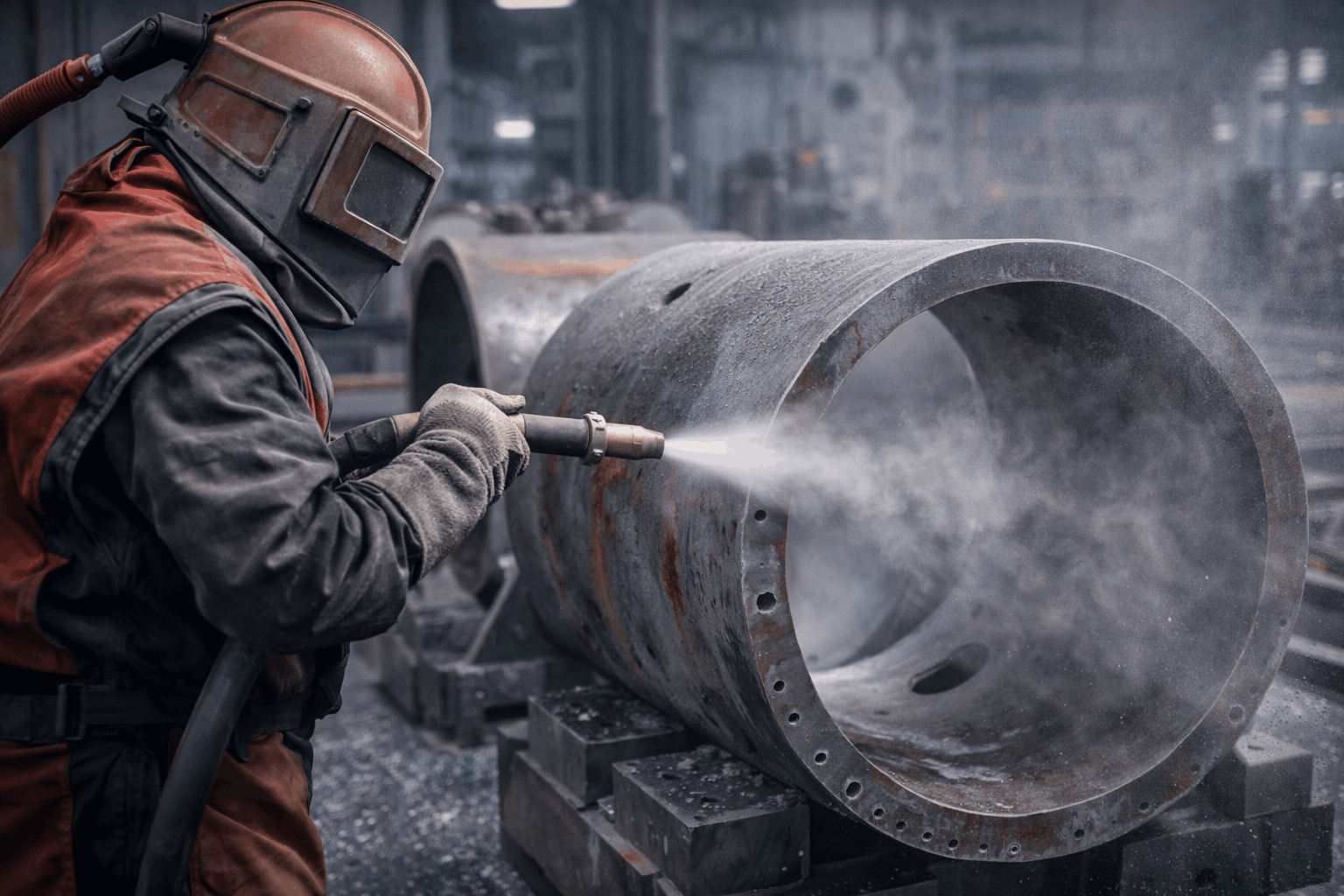
Surface preparation for coatings and linings: Removing rust, old coatings, mill scale, and contaminants to create a profile that ensures coating adhesion and service life.
Cleaning and decontamination: Removing deposits, scale, fouling, and contaminants from equipment and structures to restore performance.
Specializations
Profiling and finishing: Achieving specified surface roughness or profile for mechanical fitting, welding preparation, or aesthetic standards.
Passive corrosion control: Preparing and reapplying protective systems to extend asset life and reduce total cost of ownership.
Ultra-High Pressure (Hydroblasting)
High-pressure water jets, ranging from medium (1,000–5,000 psi) to ultra-high (up to 40,000 psi), for removing heavy deposits, coatings, and fouling without introducing abrasive residues. Hydroblasting is essential where the use of abrasive media is contraindicated.
Robotic and Automated Blasting
For repeatable, high-volume or hazardous tasks, Savegen deploys robotic blasting solutions to ensure uniformity, improve throughput, and reduce operator exposure to hazardous environments.
Soft-Strip and Chemical-Assisted Systems
Complementary methods, including chemical strippers or chemical cleaning before/after blasting, where mechanical action alone does not meet project constraints or where substrate sensitivity requires combined approaches.
Media Selection and Surface Profiling
Media selection is critical for achieving target results while minimizing collateral damage:
Steel shot/grit: Preferred for heavy-duty surface preparation and profile generation where substrates are robust and high removal rates are required.
Garnet: Versatile, lower-dust abrasive suitable for coating removal and marine applications; notable for recyclability and controlled profile creation.
Glass beads: Used when surface restoration and aesthetic finish are priorities.
Aluminium oxide, silicon carbide: Maximizes cutting efficiency for hard coatings and specialized substrates. Savegen employs measurement techniques (profilometers, comparators) to verify surface roughness (e.g., SSPC-SP standards, ISO 8503) and documents profile, cleanliness, and anchor pattern as part of quality records.
Health, Safety, and Environmental Management
Blasting operations can pose significant health and environmental risks if inadequately controlled. Savegen integrates comprehensive HSE measures across projects:
Worker Health and Safety
Respiratory protection and local exhaust ventilation: Use of supplied-air systems, dust extraction units, and negative-pressure containment to limit inhalation exposure to respirable crystalline silica, lead, zinc, and other hazardous particulates.
Personal protective equipment (PPE): Blast suits, gloves, hearing protection, eye and face shields, and fall protection where required.
Training and competency: Operators are trained and certified in blasting techniques, hazard recognition, emergency response, confined-space entry, and equipment maintenance.
Shot-blast wheel and nozzle safety: Regular inspection, maintenance, and guarding of mechanical parts to prevent catastrophic failures.
Environmental Controls
Dust suppression and containment: Use of wet blasting, enclosed systems, vacuum recovery, and HEPA filtration to prevent fugitive dust emissions and contamination of surrounding areas.
Waste management: Segregation, treatment, and disposal of spent media, removed coatings, and rinse water in compliance with local regulations. Where possible, Savegen recycles spent abrasives (e.g., steel shot return) to minimize waste and lifecycle cost.
Noise and vibration control: Implementing engineering controls and scheduling to mitigate community and worker noise exposure.
Regulatory Compliance
Conformance with occupational exposure limits, environmental permits, and industry-specific standards (e.g., OSHA, HSE, EPA, local environmental agencies). Savegen maintains documentation and monitoring data to demonstrate compliance.
Surface Inspection and Quality Assurance
Quality assurance is foundational to Savegen’s service delivery, ensuring blasting outcomes meet technical specifications and are compatible with subsequent protective systems.
Pre-Blast Assessment and Planning
Substrate assessment: Metallurgical condition, remaining coating thickness, corrosion extent, and structural integrity inform the chosen blasting approach.
Compatibility checks: Ensuring selected abrasives, blasting pressures, and profiles are suitable for the substrate and intended coatings.
In-Process Controls
Measurement and verification: Regular checks using blast profile gauges, soluble salt testing (ISO 8502), visual cleanliness standards (e.g., SSPC-SP10/NACE 2, ISO 8501), and surface contaminant monitoring to ensure consistent performance.
Documentation: Detailed test records, batch logs, and photographic evidence maintained for client review and audit.
Post-Blast Treatment and Coating Application
Timely coating application: Minimizing exposure between blasting and coating to prevent flash rust or contamination—use of blast-to-coat window planning and temporary protective measures.
Touch-up and repair: Localized reblasting and surface rectification where necessary to meet specifications.
Project Management and Delivery
Savegen’s project delivery model combines technical expertise with structured project management to meet schedule, budget, and performance expectations.
Project Scoping and Proposal
Site survey and risk assessment: Detailed site investigations to define access, containment needs, environmental constraints, and safety requirements.
Technical proposal: Scope of work, method statements (IMS/Method Statements), risk assessments, resource planning, equipment lists, and commercial terms.
Mobilisation and Site Logistics
Equipment selection and mobilisation planning: Selecting blast pots, compressors, abrasive inventories, containment, and recovery systems appropriate to the scope.
Workforce planning: Deploying suitably skilled teams including supervisors, blasters, safety officers, and quality inspectors.
Execution and Coordination
Integrated scheduling: Coordination with client operations, shutdown windows, and other contractors to minimize downtime and optimize resource utilization.
Communication and reporting: Routine progress updates, HSE reporting, and quality documentation transmitted via standardized channels.
Demobilisation and Close-Out
Site restoration and waste removal: Ensuring all spent media and operational detritus are removed and the site is restored to contractual standards.
Handover: Delivery of final test records, quality certificates, and warranties or guarantees as stipulated.
Environmental and Sustainability Considerations
Recognising rising client and regulatory expectations for sustainability, Savegen integrates practices to reduce environmental footprint:
Media recycling: Reclamation systems for steel shot and grit reduce consumption and landfill disposal.
Low-dust and wet blasting technologies: Decreasing airborne emissions and contamination risks.
Water treatment and reuse: Systems to manage wash water and reduce freshwater demand when hydroblasting is employed.
Energy efficiency: Optimising compressor usage, adopting modern high-efficiency equipment, and planning to reduce idle times.
Sector-Specific Applications and Case Examples
Savegen’s blasting expertise applies across multiple sectors:
Marine and offshore: Hull and topside blasting to remove marine growth, corrosion, and to prepare for anti-corrosion coatings; execution under salt-laden atmosphere and often within confined or dynamic environments.
Petrochemical and refineries: Preparation of pressure vessels, storage tanks, piping, and structural steel during shutdowns; contamination control is critical due to hazardous residues.
Power generation: Turbine component refurbishment, boiler and heat exchanger cleaning, and surface preparation for protective coatings in both fossil and renewable energy settings.
Infrastructure and rail: Bridge and structural steel rehabilitation requiring strict environmental and public safety controls.
Manufacturing and heavy industry: Surface treatment of heavy equipment, molds, and machinery parts, requiring precision and dimensional fidelity.
Training, Competence, and Continuous Improvement
Savegen invests in workforce competence through:
Certification programs: Ensuring blasters and supervisors hold relevant certifications (e.g., NACE/ICRI/SSPC) where applicable.
Continuous improvement: Feedback loops from project reviews, incident investigations, and quality audits to refine methods and update equipment or procedures.
R&D and technology adoption: Evaluating new abrasive media, robotic systems, and monitoring tools to enhance performance and safety.
Commercial Value Proposition
Savegen’s blasting services deliver client value through:
Lifecycle cost reduction: Effective surface preparation extends coating life, reduces maintenance frequency, and lowers total cost of ownership.
Downtime minimisation: Efficient planning and execution during shutdown windows reduce production loss.
Regulatory and safety assurance: Demonstrable compliance reduces legal and reputational risks.
Technical reliability: Documented quality control ensures coating system performance and reduces rework.
Blasting is a technically demanding service that requires rigorous control of materials, equipment, personnel competence, safety systems, and environmental management. Savegen Engineering’s specialisation in blasting encompasses a wide range of techniques—abrasive, wet, hydro, peening, and robotic—applied with methodical planning, monitoring, and quality assurance. The company’s approach balances technical performance with health, safety, and environmental stewardship, delivering outcomes that meet client specifications and regulatory obligations. Through targeted media selection, precise surface profiling, robust HSE practices, and disciplined project management, Savegen enables clients to preserve asset integrity, optimise maintenance cycles, and reduce lifecycle costs.
SERVICE DETAILS
Dry abrasive blasting (pressure/venturi): Using a range of abrasives (steel shot, steel grit, garnet, aluminium oxide, glass bead) in pressure or suction systems to remove coatings and create specified surface profiles.
Wet abrasive blasting: Mixing abrasives with water to suppress dust, reduce rebound and heat, and enable blasting in sensitive environments or where containment is challenging.
Non-destructive, low-impact blasting for cleaning, peening, and achieving smooth finishes on sensitive substrates (stainless steel, aluminium). Glass bead media are chosen for aesthetic restoration and minor surface defect treatment.
Mechanical peening processes (shot peening) to improve fatigue resistance of components by inducing beneficial compressive residual stresses. Savegen specifies and documents parameters (intensity, coverage, shot size) to relevant standards.
Low-pressure, precision systems for delicate or constrained components, often used in refurbishment of turbine blades, valves, and instrumentation where dimensional integrity is critical.
Have you any question or querry
GET FREE
CONSULTATION
WITH OUR AGENT